I’ve always loved how creativity brings people together. Some of my favorite conversations happen when my hands are busy making something alongside friends. I get to see how others approach their art, exchange ideas, and sometimes learn something entirely unexpected about the people around me. There’s something wonderful about an activity that gives us a reason to gather, create, and enjoy each other’s company. For young adults navigating cancer, finding those opportunities for connection can be complicated. Friendships shift, plans get interrupted, and our experiences don’t always align with our peers’. While friends might be navigating careers, relationships, and other milestones, we may also be juggling treatment schedules, medical appointments, or the lingering effects of cancer. Having people in our lives who understand these experiences can make a meaningful difference.
Research highlights the value of these relationships. Hotchkiss and colleagues (2023) found that peer connections among adolescents and young adults affected by cancer can offer mutual understanding, personalized support, and opportunities to laugh about shared experiences. I’ve seen this firsthand, both personally and professionally. One of the most meaningful examples in my own life is a group of friends affectionately known in my phone and social media DMs as the Blood Cancer Baddies. We’re a group of women who were diagnosed with blood cancers around the same time and found our way into each other’s lives during a pretty extraordinary chapter. We all have different treatment and life experiences, but more than two years later, we’re still texting every week about everything from everyday happenings to major milestones.
We’ve supported one another through the uncertainty of life during and after cancer. In that time, one of us has welcomed a baby, some have lost family members, many of us have experienced recurrences and health scares, and others have moved or started new jobs. We’ve celebrated, grieved, laughed, and watched one another’s lives evolve. What began as a connection through blood cancer has grown into a friendship that keeps changing as we do. I love that we’ve gotten to witness the exciting, heartbreaking, and wonderfully ordinary parts of each other’s lives. Cancer may have introduced us, but so much more keeps us connected years later.
More Than an Art Project
Think about the last time you created something alongside another person. Maybe you attended a workshop, painted pottery with friends, colored with a kiddo, or spent an afternoon crafting around the kitchen table. Between sharing supplies, exchanging ideas, and occasionally wondering whether you’ve completely misunderstood the instructions, there’s plenty of room for conversation and connection. This is the bread and butter of Cactus Cancer Society programming.
Developmental psychology offers a concept that offers an interesting way to think about this: parallel play. Traditionally, it describes young children playing independently alongside one another, but the idea also offers a useful perspective on how we connect as adults. Sometimes, simply sharing space while doing our own thing can create companionship without the pressure to talk or interact constantly. Creative activities offer a particularly lovely opportunity for this. We can work on completely different projects, occasionally peek at what someone else is making, swap ideas, laugh at our happy accidents, and enjoy being together.
There’s some interesting science behind why these experiences can be meaningful, too. A World Health Organization review examining evidence from more than 3,000 studies found that participating in the arts can support health and well-being through several pathways, including emotional expression and social interaction (Fancourt & Finn, 2019). More recent research has explored how creativity can help build community. Sonke and colleagues (2025) reviewed 18 publications examining the relationships between arts participation, social cohesion, and well-being. Their findings suggest that participating in the arts can help foster relationships, belonging, and a sense of community. They also highlighted how these connections may encourage continued participation in creative activities, giving relationships opportunities to grow over time.
Part of what makes art so compelling in group settings is that it gives people something to experience together. In therapeutic spaces, we often emphasize the creative process over the finished product, recognizing that the experience of making art can be just as meaningful as whatever ends up on the page. Through colors, images, stories, and shared meaning, we can express ourselves, spark conversations, and discover things about one another that might not have come up otherwise. Two people can receive the exact same prompt and create completely different things, each bringing their own experiences, perspectives, and personalities into the process. For young adults affected by cancer, creative spaces give us opportunities to connect through shared experiences while making room for the interests, identities, and parts of ourselves that extend beyond our diagnoses. We might discover something new about another person, recognize a familiar feeling in their artwork, or simply enjoy creating alongside someone who understands a little of what we’ve been through.
An Argument For Risk Taking: For All Who Dream
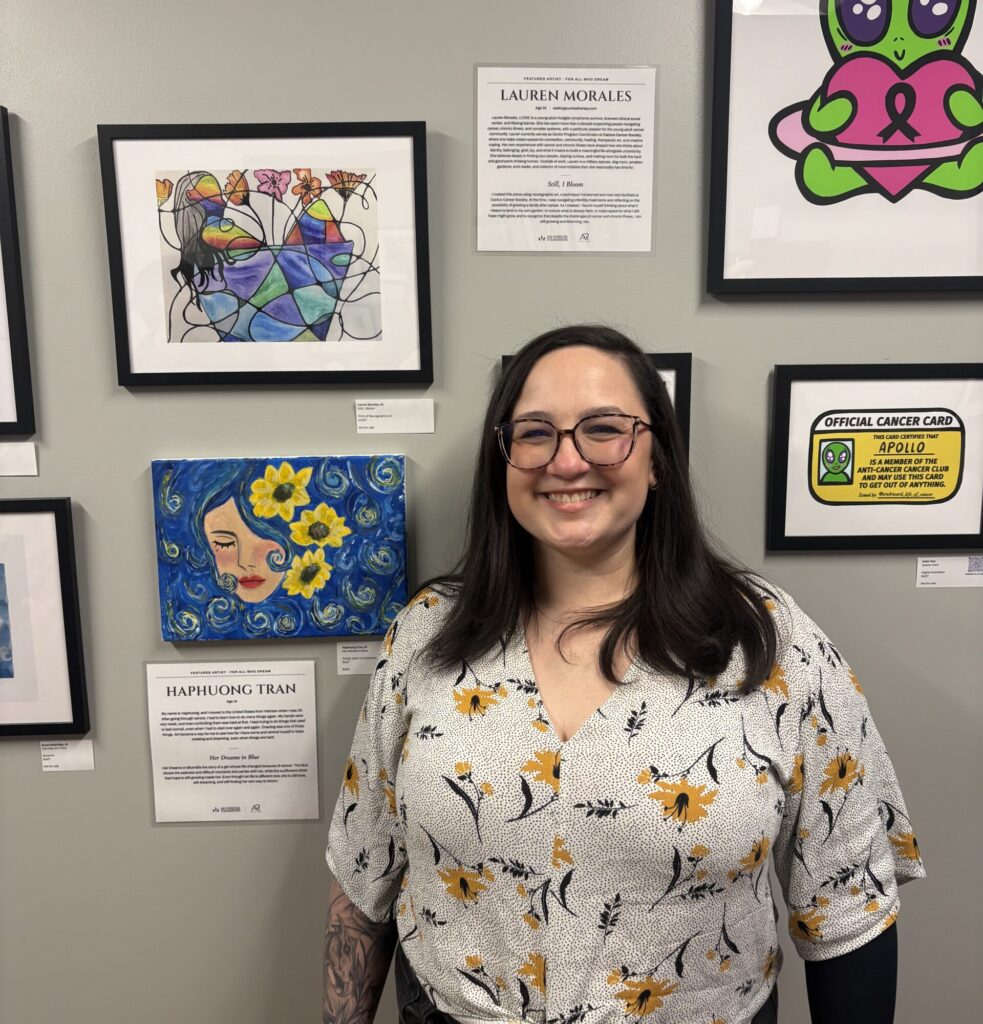
Recently, I had the opportunity to participate in For All Who Dream, an art gallery showcase hosted by HH Forever Foundation, an organization inspired by the life and legacy of Harry Hyun that creates artistic opportunities and community experiences for young adults affected by cancer. I initially hadn’t thought about applying, but a friend encouraged me, and I’m so glad I did!
My artwork was displayed alongside pieces from other incredibly talented creatives whose lives have been touched by cancer. Walking through the gallery and seeing everyone’s different styles, perspectives, and artistic voices was such a meaningful experience. I loved being surrounded by people who had brought their own creativity into the same space, each with something unique to share. I also brought my partner, which made the experience even more meaningful. While I had opportunities to meet fellow survivors and artists, he could connect with other partners and co-survivors who understand what it’s like to navigate cancer alongside someone they love. That mattered to me because cancer affects our relationships and support networks, and the people who walk alongside us deserve opportunities for connection, too.
The experience reminded me of something I appreciate about creative communities: art can bring us into the same room, but the conversations, shared experiences, and meaning we make together help those connections grow. Seeing everyone’s work, hearing their stories, and sharing the experience with my partner made the evening memorable in ways that extended well beyond the gallery walls.
Finding Your Creative Community
I left For All Who Dream feeling grateful for the opportunity to share my artwork, celebrate other artists, and spend time with people whose paths I might not have crossed otherwise. Putting my art out into the world meant stepping outside my comfort zone, and that decision opened the door to conversations, experiences, and connections I wouldn’t have had otherwise. When I think about that evening and the friendships I’ve built with the Blood Cancer Baddies, I’m reminded that some of the most meaningful relationships in my life have grown from opportunities I couldn’t have anticipated and from feeling the fear of trying something new, and doing it anyway.
Building community takes opportunities to meet, space to get to know one another, and the willingness to keep showing up as our lives evolve. For young adults affected by cancer, having people who can celebrate our milestones, sit with us through uncertainty, and appreciate all the other parts of who we are is incredibly valuable. That’s the kind of connection I hope we continue creating, both within and beyond cancer spaces. At Cactus Cancer Society, we love seeing what happens when young adults affected by cancer come together to create. Through programs like our Art Workshops and Creative Arts Book Club, participants explore creative and therapeutic art activities, journaling, idea-sharing, and connection with people who bring their own experiences and perspectives to the group. Our other free virtual programs, including Sketchy Business, Coffee & Oodles, and Inner Canvas, offer even more drop-in opportunities to explore creativity and community, with accessibility front of mind. You don’t need artistic experience, fancy supplies, or an impressive finished piece to join in. Your curiosity and willingness to show up are plenty! If you’re looking for connection, consider what kind of creative space might feel right for you. Do you enjoy chatting while you create? Would you prefer a quieter space where you can work alongside others? Are you hoping to meet people who understand cancer, share your creative interests, or both? There are so many ways to build community, and what feels meaningful to you may change over time.
A journal prompt for you: Think about the people who have become part of your story during or after cancer. How did you find one another, and what has helped those connections grow?
Further Reading & Resources
Looking for more ways to find your people? These organizations are great places to start.
- Cactus Cancer Society: Young Adult Cancer Resource Directory
Explore organizations, programs, and resources supporting young adults affected by cancer, including creative expression, peer connection, and practical support. - National Cancer Institute: Adolescents and Young Adults with Cancer
Find information and resources designed for adolescents and young adults navigating cancer. - HH Forever Foundation
Discover artistic opportunities and community experiences for young adults affected by cancer, including the For All Who Dream gallery showcase.
References
Fancourt, D., & Finn, S. (2019). What is the evidence on the role of the arts in improving health and well-being? A scoping review (Health Evidence Network synthesis report No. 67). World Health Organization Regional Office for Europe. https://www.ncbi.nlm.nih.gov/books/NBK553773/
Hotchkiss, M. E., Ahmad, Z. N., & Ford, J. S. (2023). Cancer–peer connection in the context of adolescent and young adult cancer: A qualitative exploration. Journal of Adolescent and Young Adult Oncology, 12(1), 83–92. https://doi.org/10.1089/jayao.2021.0170
Sonke, J., Pesata, V., Colverson, A., Morgan-Daniel, J., Rodriguez, A. K., Carroll, G. D., Burch, S., Abraham, A., Akram, S., Marjani, S., Belden, C., & Karim, H. (2025). Relationships between arts participation, social cohesion, and well-being: An integrative review of evidence. Frontiers in Public Health, 13, Article 1589693. https://doi.org/10.3389/fpubh.2025.1589693