AYA Awareness Week: What We’re Still Missing

April 6th through April 10th is Adolescent and Young Adult (AYA) Cancer Awareness Week, a time dedicated to bringing attention to the unique realities of people diagnosed with cancer between the ages of 15 and 39, a group that often falls in between pediatric and older adult care and is frequently overlooked in research, resources, and support.

According to the National Cancer Institute, about 89,000 young people in this age range are diagnosed with cancer each year in the United States, accounting for about five percent of all diagnoses.

What’s less often talked about is that for some cancers, rates are actually rising in younger generations. According to the American Cancer Society, colorectal cancer in people under 50 has been increasing by about 2–3% each year, even as rates decline in older adults. It has also become one of the leading causes of cancer-related death among young adults, with about 1 in 5 new cases now diagnosed in people under 55.

The National Cancer Institute notes that young adults are also more likely to be diagnosed at later stages, in part because symptoms are often dismissed or attributed to less serious conditions. And this trend isn’t limited to one type of cancer. Research highlighted by the National Institutes of Health shows that several cancers, including breast, pancreatic, kidney, and colorectal, are increasing in younger generations, pointing to a broader shift in cancer trends.

So yes, awareness matters. But awareness alone doesn’t change what it feels like to be dismissed in a doctor’s office, or to navigate disability, fertility, identity, and everything in between. Recently, our Rooted Voices Advisory Board came together to reflect on AYA Awareness Week. We asked a simple but honest question: What’s really needed in the AYA space with all that is going on the world today? What emerged was thoughtful, direct, and deeply grounded in lived experience.

Here are a few of the themes that came forward.

Being taken seriously, earlier

Many young adults shared how difficult it can be to get answers when their concerns aren’t taken seriously. Being told you’re “too young,” reassured too quickly, or asked to wait it out can delay diagnosis and add another layer of stress to an already overwhelming experience.

Several board members described having to push for testing or advocate more strongly than expected, especially when symptoms were initially minimized. Over time, this can create hesitation. People begin to question their own instincts, wonder if they’re overreacting, or delay speaking up again, even when something still feels off.

Board members also pointed to the need for stronger provider training in bedside manner, clearer guidance for young adults on when and how to advocate for additional testing, and clinical environments where concerns are met with curiosity instead of dismissal. Small shifts in how concerns are received can make a meaningful difference, not just in outcomes, but in how safe and supported someone feels seeking care.

Turning advocacy into something tangible

Accessible education around prevention and early detection, including HPV vaccines, pap smears, mammograms, and genetic testing, was also highlighted as an ongoing need. Without clear, centralized information, many young adults are left to piece things together on their own or learn about options later than they should.

That same gap shows up in how we talk about self-advocacy. It’s often encouraged, but not always explained in a way that feels usable in real moments of care.

Board members expressed interest in more concrete, shared tools, such as a toolkit or living resource document that young adults can return to and build on over time. This could include language for how to approach second opinions, guidance for navigating pushback or uncertainty, and clear next steps when care is denied or delayed.

Tools like this can help make advocacy feel more possible, especially in moments when it’s hardest to know what to say or do.

Making space for grief in all its forms

Grief showed up in many different ways in this conversation. Not only in response to loss, but in the ongoing, layered ways it can exist alongside a cancer experience. Changes in identity, plans, relationships, and sense of certainty all carry their own forms of grief. They identified a need for ongoing spaces to process grief, community-based ways to remember and honor those who have died, and support that acknowledges grief as an integral part of the experience, not something separate from it. 

Making resources easier to find and use

A number of participants reflected on how difficult it can be to find and navigate available resources. They shared that finding information and resources about fertility preservation and storage, financial assistance and grants, insurance navigation and appeals, and workplace and school accommodations has been challenging. In many cases, resources do exist, but they are scattered or not clearly communicated. There is a strong desire for more centralized, easy-to-understand information that young adults can actually use in real time.

Expanding what support can look like

Support groups can be meaningful, but they may not meet every need. Young adults are often navigating multiple layers of experience at once, and many are looking for support that feels more tailored and reflective of who they are. This includes identity-affirming spaces, creative and flexible ways to process and connect, and broader representation across cancer types, including rare diagnoses. Support is most effective when it reflects the complexity of the people it’s meant to serve.

What We’re Doing (and Still Learning)

At Cactus Cancer Society, AYA Awareness Month is not just about visibility. It’s about listening and responding.

Many of our programs are shaped directly by conversations like this:

  • Creative spaces like The Inner Canvas, where grief and identity can be explored without pressure
  • Programming that centers lived experience alongside professional insight
  • CE Programs where providers can learn more about how to effectively support YAs with cancer 
  • Ongoing efforts to make resources more visible, usable, and relevant, including our recently updated resource section 

And we know there is still more to build.

Awareness Isn’t the End Goal

AYA Awareness Month matters. Awareness is only the beginning. What young adults are asking for is care that is informed, accessible, and responsive to the reality of their lives.

Part of that is in the small moments. Like being listened to, being taken seriously, having access to information that’s actually clear and easy to find, knowing what questions to ask, and feeling supported enough to ask them.

It’s also in the way support shows up over time. Not just at diagnosis, but in the in-between, in the long-term, and in the parts that don’t always get talked about. We’ll keep listening. And we’ll keep building alongside this community.

Got feedback you want to share with us on what you think the YA Cancer Community needs? Reach out to us at info@cactuscancer.org 
Ask Perrie: Reclaiming Your Voice

Dear Perrie,

How do you advocate for yourself at doctors’ appointments and hospitals when you have been failed by the medical system before? (ie. missed diagnosis and now new problems are arising….)

Dear Reclaiming Your Voice,

This is such an important question, and I’m so glad you asked it! The truth is that many young adult cancer survivors experience medical mistrust. In the U.S., it’s not uncommon to encounter providers who are burnt out, overworked, and treat patients like numbers rather than people. Missed diagnoses, medical gaslighting, and difficulty trusting the system again are, unfortunately, experiences I have heard from many other young adult cancer survivors.

Despite that, we still have to advocate for ourselves. Recognizing and validating the real barriers and emotions that might get in the way is an important first step. Pushing through with a toxic positivity mindset isn’t very sustainable and can often leave folx feeling even more frustrated than before.

If you find yourself shutting down during appointments, you may need a way to come back into your body and stay present, using tools like mindfulness, fidgets, note-taking, or asking for follow-up appointments. If you find yourself overwhelmed, triggered, or angry in these appointments, you may need to practice deep regulation and communicating your concerns, even when big feelings are in the room.

A helpful tip, in any situation, is to start keeping an organizational system. You likely have access to a virtual chart, and if so, I would practice reviewing your medical notes, labs, and visit summaries before appointments. I’ve recommended to people in the past to have their own medical binder or notebook. But really, you can grab any piece of paper or even the notes section of your phone and jot down your thoughts and the top 5 questions you want to address in your next appointment. Organizing yourself this way can help you stay grounded in what is most important to cover in your appointments, even when you are feeling overwhelmed, scared, or tapped out. 

It can also be incredibly supportive to bring someone with you to appointments when possible. Having a support person can be another great grounding tool and a way for someone to have your back when you need to speak up for yourself. If it’s not possible to have a support person, you could also ask permission to record doctors’ appointments so you can listen back to them later. Recording offers a way for you to review information and return to it, a helpful strategy if it takes time for you to process information. 

It’s also completely okay to ask your provider to slow down. If something is confusing, or they are using a term you don’t understand, it’s okay to ask, “Can you explain that another way?” or “Can you walk me through your thought process as to why this test is the best option, or this other option isn’t a good idea?” Asking providers to clarify their reasoning and thoughts can help you to better understand your care and give you the opportunity to notice if your concerns are being taken seriously. If you find that you are consistently being dismissed, even after you’ve spoken up, then it might be time to pivot.

An important part of self-advocacy is remembering that seeking a second opinion or switching providers is not offensive; it is an act of prioritizing your needs. After all, this is your health! This is a normal and reasonable part of medical care for young adults with cancer or complex medical histories. Seeking another perspective or giving yourself permission to find a new doctor with whom you develop a better relationship does not mean you are difficult; it means you are taking your health seriously. 

Finally, I want to acknowledge that rebuilding trust in medical spaces can take time. If you find that you are still struggling, I want to gently encourage you to reach out for therapy, community support, or other spaces where you can process these experiences. Medical trauma is real, and you deserve support in navigating the impact it may have had on your relationship with healthcare. Advocating for yourself does not mean you have to be perfectly confident or fearless. Sometimes it simply means showing up, asking the question anyway, and reminding yourself that your experiences in your own body matter.

You deserve to be heard. You deserve to be believed. And you deserve care that takes you seriously.

In your corner,
Perrie 

Ask Perrie is Cactus Cancer Society’s advice column for the questions that young adult cancer doesn’t come with instructions for. Community members submit anonymous questions, and Perrie offers thoughtful guidance, perspective, and practical ideas for navigating life during and after cancer.

Ask Perrie: Got Big Questions

Dear Perrie,

How do we cope with the major fear of recurrence for the rest of our hopefully long lives?

How do we choose a career where we do not want to waste our time and be fulfilled, but also gives us the stability and health benefits, especially after experiencing such a traumatic part of our lives?

Dear Got Big Questions,

I’m going to do my best here to be a supportive place to land with these concerns, because they are some heavy and really common concerns among YA cancer folks. First, I want to name something important. Fear of recurrence is a huge part of young adult cancer. So much so that research consistently identifies it as one of the top three long-term aftereffects experienced by AYA survivors. I share that not to make it feel inevitable, but to normalize the experience. You are not alone in this fear, and many struggle to navigate it. 

When you’ve lived through something as traumatic and life-altering as cancer, it makes sense that your brain and body remain alert to the possibility that it could happen again. Your mind is trying to protect you! The tricky part is that this protective system sometimes stays on high alert long after treatment ends (or longer than necessary). 

Navigating fear of recurrence will look different for everyone. For some people, it means working with a trusted therapist who understands cancer survivorship. For others, it means finding community spaces where they can talk openly with people who truly understand the experience. And for many others, it takes space and time (ugh, I know, I know….time?!?) for healing as your mind, body, and soul adjust to your reality. 

Here are a few approaches that I’ve found personally and professionally helpful in dealing with fear of recurrence: 

Let the feeling exist.
Trying to force fear away often makes it louder. Acknowledging that fear is present can sometimes soften its grip. For many people, fear of recurrence does not completely disappear; it softens with time and grows quieter with experience navigating it. I don’t say that to scare you, but to name a truth that many experience: Sometimes the work becomes less about getting rid of fear and more about learning how to let the fear exist without letting it run your life. You see, the more we try to avoid fear, the bigger it can become. You might experiment with gently allowing yourself to be scared while still doing the important things in your life. You might even try practicing being with the fear in small increments on purpose. Yes, I know that sounds a little strange, but stay with me. The more you practice letting the feeling exist, the easier it can be to navigate when it inevitably knocks on your door. 

Bring yourself back to what you actually know to be true.
Fear has a way of pulling our minds into imagined futures. When that happens, try to anchor yourself in the present moment. What do you know to be completely true right now? Right now, you are here in this moment. Right now, you are living your life inside of trauma or new symptoms. Right now, you are doing your absolute best to cope. Bringing your brain back to the current moment is not only an exercise in reeling your thoughts in, but an act of mindfulness. The practice of paying attention to the current moment, on purpose, without judgment. Mindfulness has been shown, across a multitude of studies and cultural practices, to be a cornerstone of resilience and psychological health. When you notice your brain in future-tripping land (as I lovingly call it), try to see if you bring it back to what’s right in front of you through art, music, or another novel experience. It should help take the temperature down! 

Additionally, if you are unsure what symptoms should prompt a call to your oncologist, ask them directly. Having that information can be incredibly grounding. Keep a list of those symptoms somewhere accessible (looking at you, iPhone notes app) so when your brain starts spiraling, you have something concrete. Sometimes that reminder helps us see that our mind is trying to protect us from a future that has not arrived.

Give the fear somewhere to go.
Talking about it with trusted people, journaling, creative expression, therapy, or support groups can help move fear out of your head and into a space where it can actually be processed. Giving your body an opportunity to release some of that energy can be really important for your nervous system and overall mood management. Things like movement, physical activity, grounding exercises, or emotional processing in safe spaces are all ways to help your nervous system move through fear instead of holding it alone. Give yourself and your body an opportunity to chew through the feelings by finding which activities work best for you. 

Your second question about choosing a career after cancer is another really big one. Choosing a career that balances your needs is already a complicated process in young adulthood. When cancer enters the picture, those decisions can start to feel even heavier. It makes sense that you might feel overwhelmed or even frozen when trying to choose something that is both meaningful and stable. Cancer often changes our relationship with time. Suddenly, the idea of wasting time can feel terrifying. There can be pressure to find work that feels deeply fulfilling while also making sure you have stability, health insurance, and enough flexibility to take care of your body.

The truth is that most people build meaningful lives in layers rather than through one perfect decision.

Give yourself some grace to make the next best choice you can in this moment, and maybe even some permission to change your mind later. As you continue to grow as a human, your needs and priorities may shift or evolve. That may mean a professional pivot somewhere down the road, and that is okay (and to be expected, growing and changing is so so human). 

Some tough love here: you do not have to solve the rest of your life today, even if your brain is trying to convince you that you should. 

If you still find yourself feeling stuck on the career piece, it may be helpful to work with a career coach, academic advisor, or another professional who can help guide you through what matters most to you right now. Sometimes, simply exploring your options with someone who understands the process can relieve some of the pressure to find a path that checks every box all at once.

The fact that you are asking these questions tells me you are paying close attention to the life you want to build. That kind of reflection can feel heavy sometimes, but it can also lead to a life that feels deeply intentional. What a wonderful paradox. 

Wishing you courage as you keep asking the big questions,
Perrie


Ask Perrie is Cactus Cancer Society’s advice column for the questions that young adult cancer doesn’t come with instructions for. Community members submit anonymous questions, and Perrie offers thoughtful guidance, perspective, and practical ideas for navigating life during and after cancer.

We’re Turning 11 — And You’re Invited 🎉🌵

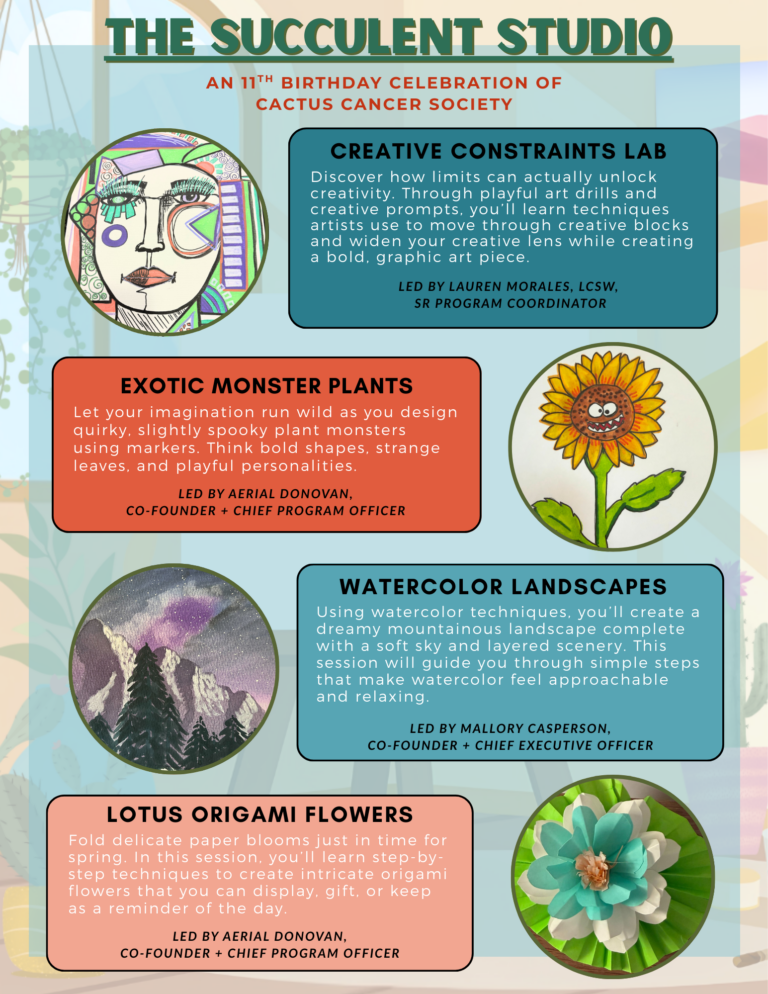
Eleven years ago, Cactus Cancer Society launched as a nonprofit with a simple but radical belief: Survival is insufficient.  Young adults facing cancer deserve more than survival.  They deserve connection, creativity, and community. Since then, thousands of young adults have joined us in art workshops, writing workshops, book clubs of all varieties, LEGO-building sessions, and brave conversations where anxiety lessened, isolation softened, and voices were validated, uplifted, and empowered. This year, we’re celebrating 11 years of impact in the most “Cactus” way we know how: an all-day celebration of creativity, community, and connection. We have 4 ways we can celebrate together!

1. Join the Birthday Celebration

At the heart of it all is our online birthday celebration, a 5-hour creative fundraiser happening Saturday, April 18th (9 am–2 pm PT / 11 am–4 pm CT / 12 pm–5 pm ET). Throughout the day, you’ll join four live, hour-long art tutorials led by Cactus Cancer Society staff. These sessions are welcoming and low-pressure, whether you’re brand new to art or ready to try something different. You’ll explore creative drills in the Constraints Lab with Lauren Morales, LCSW; design exotic monster plants with Aerial Donovan; paint watercolor landscapes with Mallory Casperson; and close with origami lotus flowers. We’ll also announce the Young Adult Advocate of the Year (YAAY), close out the birthday auction, and spend time in real connection with community. This isn’t just a virtual event. It’s a space to make something, feel something, and be part of something.

Ticket Options:

  • $50 — Live Event Access
    Full access to the 5-hour celebration, including all tutorials and the award presentation

  • $75 — Live Event + Bonus Creative Guide (PDF)
    Includes a beautifully designed guide with prompts, supply lists, and ways to keep creating afterward

  • $150 — Live Event + Guide + Supply Box
    Includes everything above, plus a curated supply box with over 25 materials (valued at $200+) so you can follow along in real time

  • $250 — Birthday Champion
    Includes everything above, plus recognition during the event as a Birthday Champion supporter

Every ticket helps fund free creative coping programs for young adults navigating cancer. Get your ticket 

 2. Bid in the Birthday Auction

In the days leading up to the celebration, we’ll host an online art auction featuring work by members of our young adult cancer community. Each piece carries its own story, moments, and meaning beyond the canvas. This is art supporting art. Every bid helps us continue offering free, creative coping programs for young adults impacted by cancer. The auction will close during the live celebration, so join us to catch the final moments and celebrate alongside the artists.

More details coming soon! 

 3. Give a Birthday Gift

If attending isn’t in the cards for you, you can still be part of this. A birthday gift directly supports free creative programs, peer connection, and survivor-led spaces for young adults facing cancer. It helps ensure that someone logging in from an infusion chair, from recovery, or from a moment of uncertainty finds a place where they can exhale and be met with care.

Give a birthday gift 

 4. Support YAAY (Young Adult Advocate of the Year)

This year’s Young Adult Advocate of the Year candidates are thoughtful, driven individuals working to change what support looks like for young adults with cancer. Over the coming weeks, supporters will “vote” with their dollars to help select this year’s advocate. It’s not just a competition. It’s a way to uplift voices, share stories, and fund programs that make a real difference.

Learn more & support a candidate

Thank You For Being Here 

This celebration is about more than a milestone. It’s about everything that has been built over the past eleven years, the art made in hard seasons, the conversations that helped someone feel seen, the moments where isolation softened just a little. It’s about what happens when creativity becomes a coping tool, and community shows up in real ways.

However you choose to take part, whether you join us live, bid on a piece, support an advocate, or give what you can, you are part of what makes this possible. We’re so grateful you’re here, and we can’t wait to celebrate together.


Through the Lens: Young Adult Cancer Survivors Share Their Stories in a National Photo Exhibit

Cancer stories are often told in tidy arcs or in medicalized language. Diagnosis. Treatment. Ring the bell. Survivor. Move forward.

Young adult survivors, patients, caregivers, and co-survivors know it rarely works that way.

Life within and after cancer can be messy, quiet, complicated, funny, exhausting, beautiful, and uncertain all at once. It can mean navigating work, school, parenting, and relationships while balancing chemotherapy, surgery, or radiation. It can mean celebrating no progression of disease while still carrying the burden of scanxiety and frequent oncology appointments. It can mean holding grief and gratitude in one hand or rebuilding a sense of identity when the person you were before cancer feels lost. 

The Through the Lens: Life Beyond Young Adult Cancer Photovoice Exhibit invites the public into those realities. This exhibit is part of the Through the Lens national campaign, a creative and research initiative developed by the School of Social Work at Colorado State University and curated by members of the Serious Illness and End-of-Life Narratives Lab alongside the Through the Lens Young Adult Advisory Board.

Through the Lens features artwork from 16 young adult cancer survivors across the country, bringing together photography, personal narratives, paintings, and poetry that explore what survivorship actually looks like for young adults. Instead of statistics or medical explanations, these stories come directly from the people who have lived them. The result is an exhibit that feels less like a gallery and more like a collection of lived, tender moments, showcasing the art and perspectives of young adults with cancer. 

When Survivors Hold the Camera

At the heart of this project is a creative storytelling method called photovoice. Photovoice invites people to document their own lived experiences through photography, poetry, art, and narrative. Instead of having their stories interpreted by researchers or clinicians, participants choose the moments, objects, and images that best represent their lives. For young adults navigating cancer, that kind of storytelling can be deeply powerful. It allows survivors to reclaim authorship of their experiences and share perspectives often overlooked in traditional cancer narratives. Through their art, they advocate for equitable cancer care for young adults. 

The goals of the exhibit reflect that intention.

The project seeks to increase awareness of the psychosocial impact that young adult cancer can have on identity, relationships, and developmental milestones. It amplifies the wisdom of survivors as they navigate meaning-making and rebuilding purpose. And it highlights the complex uncertainty many young adults carry long after treatment ends.

The Stories Behind Art

Credit: Colorado State University, Photovoice Exhibit Artist: Tabitha

Walking through the exhibit means stepping into deeply personal moments.

Some images capture the intensity of treatment. 

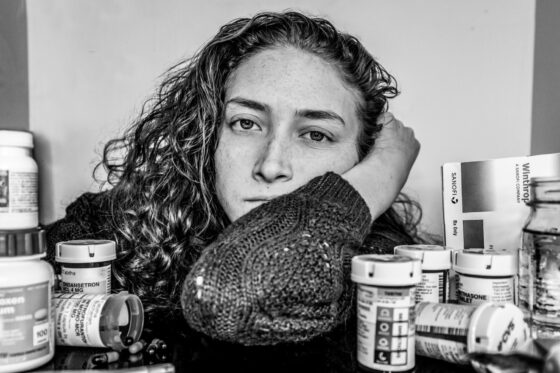
One artist shares a self-portrait taken beside a bedside table overflowing with prescription bottles and scattered medications. The photograph reflects the exhausting routine of managing symptoms and navigating a flood of treatments while already living with chronic illness.

Some photographs hold quiet spaces for reflection. 

Credit: Colorado State University, Photovoice Exhibit. Artist: April

One survivor shares images of Lake Michigan, a place she drives to on difficult days to sit with the water and reset. 

Several artists explore grief and legacy. 

Credit: Colorado State University, Photovoice Exhibit. Artist: Aerial

One photograph shows a shoreline once shared with both of the artist’s parents, who passed away from cancer. In a second image, the landscape remains the same, but the figures are gone. The absence speaks as loudly as their presence once did.

Across the exhibit, there is a shared honesty that many young adult survivors will recognize immediately. Life after cancer does not follow a single narrative. One of the most powerful elements of the exhibit is its honesty in portraying the emotional terrain that young adults often navigate after treatment. Several artists describe the feeling of living with a shadow that never quite lifts. Even on days when life feels joyful or ordinary, there can still be a quiet awareness of follow-up scans, lingering side effects, and the possibility of recurrence.

Others explore the complicated process of rebuilding identity. Who are you after cancer? How do you integrate the person you were before diagnosis with the person you have become through the experience? These are questions many survivors continue asking for years.

The exhibit does not attempt to resolve those questions. Instead, it creates space for them to exist. It offers room for these experiences to be seen, held, and empathically witnessed. In many ways, the artwork gently turns the question back toward the viewer.

Will you bear witness to the truth of our experiences?

Creativity as a Way Through

Many of the artists describe creativity as part of their healing process.

Photography, painting, and storytelling offered a way to slow down and reflect during recovery. One artist shares how creating art helped quiet the judgmental voice that often demanded perfection, allowing space to simply exist.

Another artist describes photography as a way to document moments during treatment that felt surreal or impossible to explain. Capturing those moments created a form of proof that the experience was real, something they could return to later to better understand what they had lived through.

Creative expression does not erase the hardship of cancer. But it can offer language, especially when words fall short, for emotions that are difficult to name. For many young adults with cancer, art becomes both a coping tool and a form of meaning-making in its own right.

The Team Behind Through The Lens

The Through the Lens intervention and national photo exhibit were developed by a team of researchers and oncology social workers at the School of Social Work at Colorado State University, dedicated to amplifying the voices of young adults living with cancer.

The project is led by Dr. Jen Currin-McCulloch, an Associate Professor of Social Work at Colorado State University. Her career has focused on oncology and palliative care, with a particular interest in the ways people find hope and meaning while living with serious illness.

Through her clinical work in hospital settings, Dr. Currin-McCulloch often met young adults navigating cancer who shared that medical conversations rarely included the parts of life that still brought them joy or purpose. That observation became the spark for creating a space where young adults could explore those questions together.

See the Exhibit in Fort Collins

The Through the Lens: Life Beyond Young Adult Cancer photo exhibit will be on display in Fort Collins, Colorado, this April.

Exhibit Hours
April 8 to April 12
12:00 PM to 6:00 PM MST

Reception
Saturday, April 11
3:00 PM to 5:00 PM MST

Location
Center for Creativity
200 Mathews St
Fort Collins, CO 80524

Visitors are invited to explore the artwork, reflect on the stories behind the images, and engage with the many ways young adults navigate life after cancer.

Organizations interested in bringing the traveling exhibit to their own community can inquire through the Through the Lens website or contact Dr. Jen Currin-McCulloch at Colorado State University at jen.currin_mcculloch@colostate.edu or call (970) 391-4941. 

What It Means to Witness

Many young adult cancer survivors spend years explaining their experiences to people who have never lived through them. This exhibit offers a different invitation.

Instead of simplifying those stories, Through the Lens allows them to exist in their full complexity. Through the lens of these artists, we are invited not just to look, but to truly see what life beyond young adult cancer can hold.

To learn more, please visit: Colorado State University Photovoice Exhibit

When Coping Gets Complicated: Substance Use & Addiction

Let’s be honest, cancer can push you to your limits. Between the fear, pain, fatigue, and endless “unknowns,” it’s no wonder so many people turn to whatever helps them get through the day. Maybe that’s a nightly drink to take the edge off. Maybe it’s pain medication that slowly became part of your routine. Maybe it’s something else entirely.

If that sounds familiar, you’re not alone and you’re not a failure for coping the best way you could at the time.

The truth is, substance use among people affected by cancer is more common than most realize. Research shows that young adults who’ve experienced cancer or trauma are at higher risk for developing patterns of problematic use (NIDA, 2020). Sometimes it starts as symptom relief; sometimes as a distraction from the emotional weight. But when that coping starts to feel like control is slipping, it’s a signal for compassion, not shame.

Coping, Not Character

Substance use is often misunderstood as a moral issue, but really, it’s a coping strategy, one that might have helped at first but now feels harder to manage. For many survivors and caregivers, it’s not about “getting high” or “checking out”; it’s about quieting the storm inside.

You might recognize yourself in one (or more) of these:

  • Feeling dependent on substances to sleep or calm down


  • Needing more of something to feel the same effect


  • Worrying about how much you’re using, but feel scared to stop


  • Hiding your use from people you love


  • Feeling guilt or shame, but not sure what to do next


If you’re nodding along, please know that this isn’t a moral failure. It’s a human response to extraordinary stress. Healing starts with curiosity, not self-judgment.

The Link Between Cancer, Pain, and Substance Use

Cancer and its treatments can cause chronic pain, fatigue, and insomnia. These are all major triggers for substance use. Prescription opioids, sleep aids, or even cannabis can provide relief, but they also come with risk. When your pain is both physical and emotional, it’s easy for the boundaries to blur.

That’s why trauma-informed addiction care is so important for survivors and caregivers. The right provider won’t shame you for how you’ve coped, they’ll help you understand why and offer healthier ways forward.

Therapies like Motivational Interviewing (MI), Acceptance and Commitment Therapy (ACT), and Harm Reduction approaches focus on meeting people where they are, not demanding perfection or abstinence. 

Finding Help That Feels Safe

Support doesn’t have to mean rehab or labels. It can start small. It can be a conversation with your doctor, a text to a helpline, or joining a harm-reduction group online.

Here are some trusted, nonjudgmental resources that offer information and support:

HAMS (Harm Reduction for Alcohol) — hams.cc

A supportive online community for people who want to reduce, moderate, or quit drinking. No judgment, no pressure — just practical tools and harm-reduction education.

Moderation Management — moderation.org

A non-abstinence-based peer program offering group meetings, online forums, and self-assessment tools for people seeking to cut back on alcohol.

Partnership to End Addiction — drugfree.org

Resources, education, and family support for young people and loved ones navigating substance use or recovery.

SAMHSA National Helpline — findtreatment.gov | 1-800-662-HELP (4357)

A 24/7, free, and confidential treatment referral and information service in English and Spanish. Great starting point for finding local or virtual programs.

SMART Recovery — smartrecovery.org

A science-based recovery community using cognitive-behavioral tools and group support for people seeking to change their relationship with substances.

Harm Reduction: Meeting Yourself with Kindness

Harm reduction means focusing on safety and self-compassion, not punishment. It’s about making small changes that lower risk while respecting your autonomy. That might look like:

  • Tracking your use without judgment


  • Setting limits that feel doable


  • Choosing safer methods or times


  • Pairing use with mindfulness, hydration, or nourishment


  • Talking to a doctor or therapist before quitting suddenly


If you relapse or slip, that doesn’t erase your progress. Healing isn’t about “getting it right”; it’s about staying connected to your own humanity.

Reaching Out Without Shame

Talking about substance use can feel scary, especially in cancer communities where vulnerability already runs high. But connection heals! Whether it’s a friend, a peer mentor, or a helpline counselor, telling someone “I’m struggling” is a powerful act of courage.

If you’re unsure where to start, Cactus Cancer Society’s Mental Health & Peer Support Resource Hub includes harm-reduction and recovery organizations that approach healing with compassion and inclusion.

You deserve care that doesn’t judge you.

You Are Not Alone

Recovery, whatever that looks like for you, doesn’t have to mean perfection. It can mean curiosity, self-respect, and a little more freedom each day.

If you’re coping in ways that no longer feel like support, reach out. There are people who get it and want to help you find your footing again.

You are not “too far gone.” You are not broken. You are doing your best, and that’s where healing starts. 💛

Ask Perrie: Waiting for the Other Shoe to Drop

Hi Perrie,

I’m about to turn 30 in two weeks, and I’ve been in remission from stage 3 triple-positive breast cancer for two and a half years now. I always struggled with taking care of myself before cancer, and now in survivorship, I struggle with the fear of losing my job due to the chronic issues I have now. I was fired while in active treatment at a different job, so it’s hard not to think it could happen again for something as minor as me having to call in sick two days in a row. Do you have any advice on how to handle that fear or advice on how to better advocate and take care of myself? 

Thank you

Dear Waiting for the Other Shoe to Drop,

Survivorship is full of polarities. There’s a push of “you should be all better now” and a pull of “I’m anything but better now.” Let’s make space for where you really are. I’m hearing that you’re juggling chronic illness, maybe even chronic pain, while also trying to take care of yourself, be an adult, pay bills, and show up as an employee. That’s a lot, and I’m probably only touching the surface!

Job insecurity carries real risk, and I don’t want to diminish or invalidate that, especially since you’ve already lived through losing a job during treatment. At the same time, I can hear how the fear of it happening again is starting to get in the way of day-to-day things like taking breaks when you need them, calling out sick, or advocating for yourself.

Giving yourself permission to take care of your body starts from within, and that often begins with self-compassion. You mentioned that caring for yourself was already hard before cancer entered the room. Survivorship can be an opportunity to gently renegotiate that relationship with yourself. Developing more self-understanding and compassion may help you rebuild trust in your own needs and limits.

If you’re open to exploring this, I’d recommend looking into the work of Kristin Neff, who researches and teaches self-compassion. Her workbook, guided meditations, and free online resources can be a helpful starting place: https://self-compassion.org/. Practicing self-compassion regularly can slowly help retrain your brain to respond with kindness toward yourself in moments of overwhelm instead of criticism or fear.

Speaking of fear, what you’re describing can also be deeply connected to anxiety. Your brain is doing what brains do best: trying to predict outcomes in order to keep you safe. The trouble is that sometimes that protective system goes into overdrive. Which, let’s be real, makes sense inside of cancer because you’ve really been through it! 

When you notice fear (whether that’s job loss or any other kind) rising, I’d encourage you to approach it with curiosity rather than judgment. That might sound counterintuitive, because most of us want to avoid fear as quickly as possible. But curiosity can help you gather important information about what you actually need in those moments.

For example, you might notice that fear shows up physically, maybe your breathing gets shallow, or your body feels restless. In that case, regulating your body through breathing or grounding exercises might help. Or maybe fear pulls you into spiraling thoughts and worst-case scenarios (honestly, relatable). In those moments, it may help to gently redirect your thinking or talk through those fears with someone you trust.

And if the fear continues to feel overwhelming, working with a qualified therapist can help navigate those patterns.

As far as advocacy goes, I want to say this clearly: advocating for your needs isn’t selfish. It isn’t a sign that you’re unreliable. It’s part of taking care of yourself so that you can keep showing up in your life and work.

If workplace accommodations might be helpful for you, I also want to point you toward a nonprofit called Cancer and Careers, which provides excellent guidance on navigating employment after cancer. They offer resources on things like intermittent FMLA, flexible work arrangements, and understanding your rights in the workplace: https://www.cancerandcareers.org/en/at-work/back-to-work-after-cancer

The truth is that we live in a culture that often prioritizes productivity and hustle over wellness and balance. Protecting your health may sometimes mean learning how to ask for flexibility or support.

At its heart, a lot of what we’re talking about here is rebuilding trust with yourself. Survivorship, and maybe even this upcoming 30th birthday, can be an invitation to try something new: listening to your body and honoring its limits, even when fear tells you there might be consequences.

You deserve a life that includes stability, self-compassion, and room to heal at your own pace.

Standing with you as you learn to take up space,
Perrie

Ask Perrie is Cactus Cancer Society’s advice column for the questions young adult cancer doesn’t come with instructions for. Community members submit anonymous questions, and Perrie offers thoughtful guidance, perspective, and practical ideas for navigating life during and after cancer.

Ask Perrie: Stuck In the Freeze

Dear Perrie,

Ever since cancer, I’ve been paralyzed by procrastination. There are so many things that need to be done that I just can’t do any of them. The phone calls, bills, having to talk to people about why the statement I got is wrong- it’s all too much. How do I move past this? I need to deal with these things head-on, but can’t bring myself to do any of it. 

I’m tired and overwhelmed.

Dear Stuck in the Freeze,

First, I want to name that what I’m hearing in your question isn’t just procrastination. Yes, you might be avoiding important tasks, but when we’re in fight-or-flight mode (fight, flight, freeze, or fawn), our nervous system sometimes tries to protect us from overwhelm by doing exactly what you described: freezing.

When that happens, it can become hard to think clearly. You might avoid tasks, numb out, or feel like you aren’t even fully present when these things are being discussed with you. That doesn’t mean you’re lazy or failing; it means your nervous system has been under a lot of pressure (and like….duh, Perrie….. Cancer is hard!)

So my guidance for moving through this starts with something simple: notice the freeze. The more awareness you can bring to those moments when you feel yourself shutting down, avoiding, or checking out, the easier it becomes to gently move through them. The first step really is awareness, as they say

You might start paying attention to how your body, thoughts, and emotions show up when you’re facing these tasks. Do you feel tension? Brain fog? A sudden urge to walk away or hide under your covers? Slowing down and getting curious about those reactions can help you respond with a little more compassion toward yourself.

From there, this becomes a divide-and-conquer situation. We’re not meant to handle hard things (or heal) alone. If you have access to a support system (friends, family, church members, online cancer buddies, etc.), consider reaching out for help. There’s no shame in letting someone shoulder a bit of the burden.

For example, someone might help organize bills into a spreadsheet, sit with you while you make calls, or help you figure out where to start. Sometimes just having another person nearby can make a task feel far less overwhelming.

If you don’t have that kind of support available right now, you might ask your medical team about connecting with a social worker or nurse case manager. Many oncology teams or insurance plans can help connect patients to someone who can assist with billing issues, financial programs, or simply advocate on their behalf. Having a professional in your corner can make a huge difference.

And finally, when in doubt: one call at a time.

Big mountains look impossible when we try to climb them all at once. Instead of focusing on every task waiting for you, see if you can bring your attention to the next smallest step. Just one. Giving yourself permission to handle the rest later (and maybe even tell yourself that’s a problem for future me!) can lower the overwhelm enough for your brain to move forward with one time. Do that practice enough and you might find that you’ve completed 3-5 next steps!  

You don’t have to solve everything today. One step is still movement.

Rooting for you,

Perrie

Ask Perrie is Cactus Cancer Society’s advice column for the questions young adult cancer doesn’t come with instructions for. Community members submit anonymous questions, and Perrie offers thoughtful guidance, perspective, and practical ideas for navigating life during and after cancer.

You Belong Here: LGBTQIA+ Cancer & Mental Health Support

Being a young adult with cancer is already complicated. Add being LGBTQIA+, and it can feel like an entirely different universe of isolation. Whether it’s navigating healthcare systems that weren’t built with you in mind, worrying about finding affirming providers, or just trying to hold your identity steady through treatment….it’s a lot.

But here’s the truth: you don’t have to shrink yourself to fit into the cancer world. You deserve care that sees all of you: your queerness, your pronouns, your partnerships, your body, your story, and honors it.

When Cancer Intersects with Identity

For LGBTQIA+ young adults, cancer care can stir up layers of stress that most providers never think about. You might worry about being misgendered in the exam room, having to out yourself to every new nurse, or finding a therapist who understands your identity. These are not small things; they shape whether you feel safe seeking care at all.

The research backs it up: LGBTQIA+ patients are more likely to experience discrimination, mental health distress, and barriers to culturally competent care in cancer settings (Power et al., 2022).

Mental health support that affirms your identity isn’t a luxury; it’s a lifeline. Whether that means talking to a queer therapist, joining a peer group, or finding LGBTQIA+ cancer spaces online, connection helps heal the parts that medical systems often miss.

The Emotional Load No One Warns You About

Cancer doesn’t hit in a vacuum. It can resurface old wounds like rejection, invisibility, trauma. Especially if you’ve spent years fighting to be seen for who you are. Hospital gowns, gendered spaces, fertility conversations, and even body changes from treatment can stir up complicated feelings about identity and autonomy.

That’s why finding spaces where you can show up fully yourself is essential. Not just to process cancer, but to rest from the exhaustion of explaining yourself over and over again.

And those spaces do exist. Below are some of the most affirming LGBTQIA+ mental health and cancer-specific resources available right now.

LGBTQIA+ Cancer & Mental Health Resources

Escape — escapeya.org

A grassroots community that offers safe, peer-led spaces and resources for LGBTQI2+ adolescents and young adults navigating cancer. Their programs are built around belonging and community care.

National LGBT Cancer Network — cancer-network.org

One of the leading voices in queer-inclusive cancer advocacy, research, and education. They provide support resources, training for providers, and policy work to make cancer care safer for LGBTQ+ patients.

NQTTCN (National Queer & Trans Therapists of Color Network) — nqttcn.com

A powerful directory and healing justice network centering queer and trans people of color. You can find affirming therapists or community healing spaces that reflect lived experience and cultural nuance.

OutCare Health — outcarehealth.org

A national directory of LGBTQ+-affirming healthcare providers. Search by specialty, location, and identity to find doctors, therapists, and clinics that prioritize inclusive care.

The Trevor Project — thetrevorproject.org

Call 866-488-7386 or text START to 678678. The Trevor Project provides 24/7 crisis intervention and suicide prevention for LGBTQ+ youth ages 13–24. Their counselors are trained, compassionate, and affirming — whether you’re in crisis or just need someone to talk to.

Trans Lifeline — translifeline.org

Call 877-565-8860 for peer-run, direct emotional support from trans community members who’ve been there. No gatekeeping, no assumptions — just real, affirming connection.

 Building Safety and Connection

Finding the right support often means unlearning the idea that you have to educate your helpers first. You shouldn’t have to explain your pronouns, your identity, or your relationship structure before getting care. The right therapist or peer space will already speak your language.

Here are a few tips for finding affirming mental health support:

  • Look for shared identity or allyship. Directories like NQTTCN, OutCare, and Inclusive Therapists make this easy.

  • Be upfront about what you need. It’s okay to ask potential therapists: “Have you worked with LGBTQIA+ clients?” or “How do you create a safe space for trans and non-binary folks?”

  • Connect through peer spaces. Programs like Escape and The Dinner Party’s LGBTQ+ tables offer non-clinical, community-based support.

  • Trust your gut. If you feel unseen, you can leave. If you feel understood, you’ll know.

You Deserve Affirming Care

Your queerness, your story, and your body all belong in your healing journey. There’s no one right way to do survivorship, and there’s no one right kind of support. The goal isn’t perfection or positivity; it’s fertile ground for resilience and healing. The right kind of support will set you up with a nourishing space to feel grounded and seen. 

If you’re ready to find an affirming therapist, group, or community, explore our LGBTQIA+ Cancer & Mental Health Resources directory on the Cactus Cancer website. You’ll find links, programs, and organizations that celebrate who you are, not just what you’ve been through.

You don’t have to edit yourself to heal. You don’t have to do this alone. You belong here, exactly as you are. 🌈


Three Things Young Adult Cancer Patients Tell Us All the Time

After more than a decade of working with young adults impacted by cancer, certain themes show up again and again. The diagnoses vary. Treatment paths look different. Life circumstances shift. Each experience is as unique as our young adults. But the emotional and physical aftereffects many young adults describe are remarkably consistent. The research backs this up. Research on adolescent and young adult (AYA) cancer survivorship highlights three of the most common long-term challenges: fatigue, fear of recurrence, and anxiety.

At Cactus Cancer Society, those same three themes come up in conversations and virtual groups with young adults across treatment, survivorship, metastatic disease, and long-term care. Here are some of the things we hear. 

1. “I’m exhausted, and no one seems to get it.”

Cancer-related fatigue isn’t just feeling tired. It’s the kind of exhaustion that doesn’t reset with sleep and often doesn’t show up clearly in labs or scans.

For young adults, fatigue collides with work expectations, school, dating, parenting, and the pressure to “get back to normal.” Many people tell us they feel misunderstood when their energy doesn’t match what others expect. This is especially true in survivorship, where there may be a societal expectation to “be back to normal now.”

What we see again and again is that fatigue isn’t something people can simply push through. It requires support that is flexible, validating, and realistic for people trying to live full lives alongside cancer.

2. “What if I relapse?”

A second theme we see in our groups is around fear of recurrence. Fear of recurrence is one of the most widely documented psychological aftereffects of cancer, and for good reason. It’s not irrational. It’s rooted in lived experience, ongoing symptoms, and the uncertainty that often comes with living life inside of cancer. 

For some young adults, that fear is consistent throughout treatment, for others, it surfaces years after treatment ends. For many, it remains part of daily life, especially for those living with metastatic or chronic cancer. 

3. “My brain won’t turn off.”

Anxiety is another experience young adult cancer patients name again and again in our online spaces. It can show up as racing thoughts, hypervigilance about symptoms, difficulty sleeping, or a constant sense that something might be wrong. Anxiety around scans is so common that young adults have coined the term “scanxiety” to illustrate the pattern of anxiety that arrives around scans. Sometimes that anxiety is tied to scans or medical appointments. Sometimes it shows up in everyday life—at work, in relationships, or when planning for the future.

For many young adults, anxiety isn’t just about cancer itself. It’s about the ripple effects cancer creates in identity, relationships, finances, and long-term planning.

So We Built a CE Course Around It

The Art of Survivorship is an on-demand continuing education course designed for social workers and helping professionals who support young adult cancer patients and survivors.

The course centers on the three aftereffects that research and lived experience consistently highlight for young adults with cancer:

  • Fatigue

  • Fear of recurrence

  • Anxiety

Rather than treating these as isolated symptoms, the course explores how they evolve across the cancer continuum and intersect with identity, access to care, culture, and life stage. We bring our experience in the creative coping space to help providers navigate these aftereffects and provide tools to young adults who might be saying, “I’m not sure what to say.” For many cancer survivors, their experiences can be hard to articulate. Creative coping and therapeutic art offer another way in. These practical tools offer regulation, expression, and meaning-making when words fall short. 

Over seven and a half hours, participants learn through:

  • Oncology social worker–led education

  • Survivor-led panels that center lived experience

  • Demonstrations of creative coping tools that can realistically fit into clinical and community settings

If This Sounds Familiar

If you work with young adult cancer patients and have ever thought:

  • “I see this all the time, but I’m not sure how to support them.”

  • “I wish I had more tools for this.”

  • “How do I help my clients use these tools outside of session?”

You’re not alone. And this course was built with you in mind! Register using the link below or share with a social worker who is looking to learn more about navigating these after effects with their patients. 

Learn more about The Art of Survivorship