Ask Perrie: Got Big Questions

Dear Perrie,

How do we cope with the major fear of recurrence for the rest of our hopefully long lives?

How do we choose a career where we do not want to waste our time and be fulfilled, but also gives us the stability and health benefits, especially after experiencing such a traumatic part of our lives?

Dear Got Big Questions,

I’m going to do my best here to be a supportive place to land with these concerns, because they are some heavy and really common concerns among YA cancer folks. First, I want to name something important. Fear of recurrence is a huge part of young adult cancer. So much so that research consistently identifies it as one of the top three long-term aftereffects experienced by AYA survivors. I share that not to make it feel inevitable, but to normalize the experience. You are not alone in this fear, and many struggle to navigate it. 

When you’ve lived through something as traumatic and life-altering as cancer, it makes sense that your brain and body remain alert to the possibility that it could happen again. Your mind is trying to protect you! The tricky part is that this protective system sometimes stays on high alert long after treatment ends (or longer than necessary). 

Navigating fear of recurrence will look different for everyone. For some people, it means working with a trusted therapist who understands cancer survivorship. For others, it means finding community spaces where they can talk openly with people who truly understand the experience. And for many others, it takes space and time (ugh, I know, I know….time?!?) for healing as your mind, body, and soul adjust to your reality. 

Here are a few approaches that I’ve found personally and professionally helpful in dealing with fear of recurrence: 

Let the feeling exist.
Trying to force fear away often makes it louder. Acknowledging that fear is present can sometimes soften its grip. For many people, fear of recurrence does not completely disappear; it softens with time and grows quieter with experience navigating it. I don’t say that to scare you, but to name a truth that many experience: Sometimes the work becomes less about getting rid of fear and more about learning how to let the fear exist without letting it run your life. You see, the more we try to avoid fear, the bigger it can become. You might experiment with gently allowing yourself to be scared while still doing the important things in your life. You might even try practicing being with the fear in small increments on purpose. Yes, I know that sounds a little strange, but stay with me. The more you practice letting the feeling exist, the easier it can be to navigate when it inevitably knocks on your door. 

Bring yourself back to what you actually know to be true.
Fear has a way of pulling our minds into imagined futures. When that happens, try to anchor yourself in the present moment. What do you know to be completely true right now? Right now, you are here in this moment. Right now, you are living your life inside of trauma or new symptoms. Right now, you are doing your absolute best to cope. Bringing your brain back to the current moment is not only an exercise in reeling your thoughts in, but an act of mindfulness. The practice of paying attention to the current moment, on purpose, without judgment. Mindfulness has been shown, across a multitude of studies and cultural practices, to be a cornerstone of resilience and psychological health. When you notice your brain in future-tripping land (as I lovingly call it), try to see if you bring it back to what’s right in front of you through art, music, or another novel experience. It should help take the temperature down! 

Additionally, if you are unsure what symptoms should prompt a call to your oncologist, ask them directly. Having that information can be incredibly grounding. Keep a list of those symptoms somewhere accessible (looking at you, iPhone notes app) so when your brain starts spiraling, you have something concrete. Sometimes that reminder helps us see that our mind is trying to protect us from a future that has not arrived.

Give the fear somewhere to go.
Talking about it with trusted people, journaling, creative expression, therapy, or support groups can help move fear out of your head and into a space where it can actually be processed. Giving your body an opportunity to release some of that energy can be really important for your nervous system and overall mood management. Things like movement, physical activity, grounding exercises, or emotional processing in safe spaces are all ways to help your nervous system move through fear instead of holding it alone. Give yourself and your body an opportunity to chew through the feelings by finding which activities work best for you. 

Your second question about choosing a career after cancer is another really big one. Choosing a career that balances your needs is already a complicated process in young adulthood. When cancer enters the picture, those decisions can start to feel even heavier. It makes sense that you might feel overwhelmed or even frozen when trying to choose something that is both meaningful and stable. Cancer often changes our relationship with time. Suddenly, the idea of wasting time can feel terrifying. There can be pressure to find work that feels deeply fulfilling while also making sure you have stability, health insurance, and enough flexibility to take care of your body.

The truth is that most people build meaningful lives in layers rather than through one perfect decision.

Give yourself some grace to make the next best choice you can in this moment, and maybe even some permission to change your mind later. As you continue to grow as a human, your needs and priorities may shift or evolve. That may mean a professional pivot somewhere down the road, and that is okay (and to be expected, growing and changing is so so human). 

Some tough love here: you do not have to solve the rest of your life today, even if your brain is trying to convince you that you should. 

If you still find yourself feeling stuck on the career piece, it may be helpful to work with a career coach, academic advisor, or another professional who can help guide you through what matters most to you right now. Sometimes, simply exploring your options with someone who understands the process can relieve some of the pressure to find a path that checks every box all at once.

The fact that you are asking these questions tells me you are paying close attention to the life you want to build. That kind of reflection can feel heavy sometimes, but it can also lead to a life that feels deeply intentional. What a wonderful paradox. 

Wishing you courage as you keep asking the big questions,
Perrie


Ask Perrie is Cactus Cancer Society’s advice column for the questions that young adult cancer doesn’t come with instructions for. Community members submit anonymous questions, and Perrie offers thoughtful guidance, perspective, and practical ideas for navigating life during and after cancer.

Through the Lens: Young Adult Cancer Survivors Share Their Stories in a National Photo Exhibit

Cancer stories are often told in tidy arcs or in medicalized language. Diagnosis. Treatment. Ring the bell. Survivor. Move forward.

Young adult survivors, patients, caregivers, and co-survivors know it rarely works that way.

Life within and after cancer can be messy, quiet, complicated, funny, exhausting, beautiful, and uncertain all at once. It can mean navigating work, school, parenting, and relationships while balancing chemotherapy, surgery, or radiation. It can mean celebrating no progression of disease while still carrying the burden of scanxiety and frequent oncology appointments. It can mean holding grief and gratitude in one hand or rebuilding a sense of identity when the person you were before cancer feels lost. 

The Through the Lens: Life Beyond Young Adult Cancer Photovoice Exhibit invites the public into those realities. This exhibit is part of the Through the Lens national campaign, a creative and research initiative developed by the School of Social Work at Colorado State University and curated by members of the Serious Illness and End-of-Life Narratives Lab alongside the Through the Lens Young Adult Advisory Board.

Through the Lens features artwork from 16 young adult cancer survivors across the country, bringing together photography, personal narratives, paintings, and poetry that explore what survivorship actually looks like for young adults. Instead of statistics or medical explanations, these stories come directly from the people who have lived them. The result is an exhibit that feels less like a gallery and more like a collection of lived, tender moments, showcasing the art and perspectives of young adults with cancer. 

When Survivors Hold the Camera

At the heart of this project is a creative storytelling method called photovoice. Photovoice invites people to document their own lived experiences through photography, poetry, art, and narrative. Instead of having their stories interpreted by researchers or clinicians, participants choose the moments, objects, and images that best represent their lives. For young adults navigating cancer, that kind of storytelling can be deeply powerful. It allows survivors to reclaim authorship of their experiences and share perspectives often overlooked in traditional cancer narratives. Through their art, they advocate for equitable cancer care for young adults. 

The goals of the exhibit reflect that intention.

The project seeks to increase awareness of the psychosocial impact that young adult cancer can have on identity, relationships, and developmental milestones. It amplifies the wisdom of survivors as they navigate meaning-making and rebuilding purpose. And it highlights the complex uncertainty many young adults carry long after treatment ends.

The Stories Behind Art

Credit: Colorado State University, Photovoice Exhibit Artist: Tabitha

Walking through the exhibit means stepping into deeply personal moments.

Some images capture the intensity of treatment. 

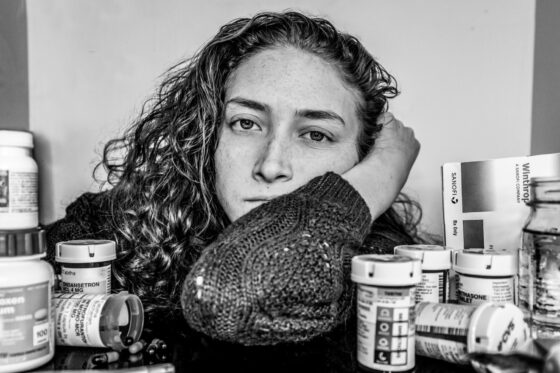
One artist shares a self-portrait taken beside a bedside table overflowing with prescription bottles and scattered medications. The photograph reflects the exhausting routine of managing symptoms and navigating a flood of treatments while already living with chronic illness.

Some photographs hold quiet spaces for reflection. 

Credit: Colorado State University, Photovoice Exhibit. Artist: April

One survivor shares images of Lake Michigan, a place she drives to on difficult days to sit with the water and reset. 

Several artists explore grief and legacy. 

Credit: Colorado State University, Photovoice Exhibit. Artist: Aerial

One photograph shows a shoreline once shared with both of the artist’s parents, who passed away from cancer. In a second image, the landscape remains the same, but the figures are gone. The absence speaks as loudly as their presence once did.

Across the exhibit, there is a shared honesty that many young adult survivors will recognize immediately. Life after cancer does not follow a single narrative. One of the most powerful elements of the exhibit is its honesty in portraying the emotional terrain that young adults often navigate after treatment. Several artists describe the feeling of living with a shadow that never quite lifts. Even on days when life feels joyful or ordinary, there can still be a quiet awareness of follow-up scans, lingering side effects, and the possibility of recurrence.

Others explore the complicated process of rebuilding identity. Who are you after cancer? How do you integrate the person you were before diagnosis with the person you have become through the experience? These are questions many survivors continue asking for years.

The exhibit does not attempt to resolve those questions. Instead, it creates space for them to exist. It offers room for these experiences to be seen, held, and empathically witnessed. In many ways, the artwork gently turns the question back toward the viewer.

Will you bear witness to the truth of our experiences?

Creativity as a Way Through

Many of the artists describe creativity as part of their healing process.

Photography, painting, and storytelling offered a way to slow down and reflect during recovery. One artist shares how creating art helped quiet the judgmental voice that often demanded perfection, allowing space to simply exist.

Another artist describes photography as a way to document moments during treatment that felt surreal or impossible to explain. Capturing those moments created a form of proof that the experience was real, something they could return to later to better understand what they had lived through.

Creative expression does not erase the hardship of cancer. But it can offer language, especially when words fall short, for emotions that are difficult to name. For many young adults with cancer, art becomes both a coping tool and a form of meaning-making in its own right.

The Team Behind Through The Lens

The Through the Lens intervention and national photo exhibit were developed by a team of researchers and oncology social workers at the School of Social Work at Colorado State University, dedicated to amplifying the voices of young adults living with cancer.

The project is led by Dr. Jen Currin-McCulloch, an Associate Professor of Social Work at Colorado State University. Her career has focused on oncology and palliative care, with a particular interest in the ways people find hope and meaning while living with serious illness.

Through her clinical work in hospital settings, Dr. Currin-McCulloch often met young adults navigating cancer who shared that medical conversations rarely included the parts of life that still brought them joy or purpose. That observation became the spark for creating a space where young adults could explore those questions together.

See the Exhibit in Fort Collins

The Through the Lens: Life Beyond Young Adult Cancer photo exhibit will be on display in Fort Collins, Colorado, this April.

Exhibit Hours
April 8 to April 12
12:00 PM to 6:00 PM MST

Reception
Saturday, April 11
3:00 PM to 5:00 PM MST

Location
Center for Creativity
200 Mathews St
Fort Collins, CO 80524

Visitors are invited to explore the artwork, reflect on the stories behind the images, and engage with the many ways young adults navigate life after cancer.

Organizations interested in bringing the traveling exhibit to their own community can inquire through the Through the Lens website or contact Dr. Jen Currin-McCulloch at Colorado State University at jen.currin_mcculloch@colostate.edu or call (970) 391-4941. 

What It Means to Witness

Many young adult cancer survivors spend years explaining their experiences to people who have never lived through them. This exhibit offers a different invitation.

Instead of simplifying those stories, Through the Lens allows them to exist in their full complexity. Through the lens of these artists, we are invited not just to look, but to truly see what life beyond young adult cancer can hold.

To learn more, please visit: Colorado State University Photovoice Exhibit

Support Our 2026 Young Adult Cancer Advocate of the Year Candidates!

Support Our Young Adult Cancer
Advocate of the Year Candidates!

Cactus Cancer Society is so proud to introduce the 2026 Young Adult Cancer Advocate of the Year (YAAY) candidates!  These passionate, driven individuals are not only raising awareness, but making a tangible impact in the lives of young adult cancer patients, survivors, and caregivers. 

Over the course of nine weeks, these inspiring candidates will raise critical funds to fuel and sustain creative coping programs that combat the loneliness, fear, and uncertainty of a cancer diagnosis. But they can’t do it alone. This is where YOU come in!

Every dollar you donate is a vote for the advocate you believe deserves the prestigious title of Young Adult Cancer Advocate of the Year. More importantly, your contributions directly fuel Cactus Cancer Society’s life-saving programs – proven to reduce loneliness, anxiety, depression, and psychological distress for young adults facing cancer. Who will take home the title of Young Adult Cancer Advocate of the Year? That’s up to you! Casting your vote today and help shape the future for young adults facing cancer!

When Cancer Isn’t Just Physical: Taking Care of Your Mental Health

Cancer doesn’t just change your body. It can reshape your identity, your plans, and your connection to the world around you. For many young adults, the emotional side of cancer can hit just as hard (if not harder) as the physical side, and it often lingers long after treatment ends.

Let’s get one thing straight: struggling doesn’t mean you’re weak. You’re responding to an extraordinary situation. The fear of recurrence, the brain fog, the sadness, the grief, the “what now?” questions, they’re normal reactions to an experience that turns life upside down! You are a human going through something extraordinary. 

Before you dive in further into this article, I want to invite you to take a breath and check in with yourself. Notice your emotional weather. If this feels heavy, pause and come back later. This content is here to support you, not overwhelm you, when you are ready. 

Below I’m going to talk about some of the common emotional responses to cancer, some of my lived experience, and recommendations I have to help support yourself inside of these experiences. 

The Emotional Whiplash of Cancer

When you hear “you have cancer,” your body can go into survival mode. Suddenly you are focused on making it to your next round of chemo or radiation, it can be common to feel as though you blinders on to the rest of the world while you navigate treatment. As your body begins to navigate the uncertainty of cancer, you might start to notice mood changes like depression, anxiety, or panic. 

You might feel it as restlessness before scans, dread before appointments, or sadness that doesn’t quite lift. These reactions are common, and I’ve had them! They’re not character flaws, they’re how your mind and body respond to uncertainty and loss. Even if treatment ends, these symptoms can stick around like uninvited guests or amplify. For me, this has felt like emotional whiplash. I went from auto-pilot in treatment to feeling completely overwhelmed in survivorship. 

A quality therapist can help you identify what you’re feeling and give those feelings room to breathe. Healing isn’t about being positive all the time; sometimes it’s about being curious, brave, or just willing to try again tomorrow. Research shows that therapists such as Acceptance and Commitment Therapy, Cognitive Behavioral Therapy, and Mindfulness are tools that can help survivors navigate the emotional whiplash of cancer. For me, I’ve found that Somatic therapies like EMDR (Eye Movement Desensitization and Reprocessing) and IFS (Internal Family Systems) to be very helpful in working through trauma. 

And something to remember small steps matter: getting out of bed, texting a friend, or joining a support group all count as movement toward healing.

The Grief That No One Talks About

Cancer brings loss in so many forms: health, independence, fertility, friendships, even the future you once imagined. This kind of grief doesn’t always get the validation it deserves. In psychology we often call this disenfranchised grief: grief that is not or cannot be openly acknowledged, publicly mourned, socially supported, or that is misunderstood or trivialized. People might say, “At least you’re alive,” when what you really need is validation and, “I know this is hard, I see you.”

Grief after cancer isn’t linear. You might feel peace one day and frustration the next. That’s okay. Think of grief as something you grow around, it doesn’t disappear, but you slowly learn to live alongside it. Grief isn’t a failure to move on. It’s evidence of how deeply you’ve lived, loved, and changed. Making space for your feelings of grief, talking about it with other YAs or survivors can often be an important step in learning how to hold grief compassionately. 

Body Image, Identity, and the Self You See Now

Many survivors struggle to recognize themselves after cancer. Scars, hair loss, swelling, weight changes……they’re visible reminders of what you’ve been through. And sometimes, it’s not just “I look different,” it’s “I feel different.”

Maybe intimacy feels different. Maybe mirrors feel like strangers. Research shows one in three survivors experiences lasting body image distress. These feelings are real and they’re workable.

Therapies that include body awareness, self-compassion, and narrative work can help you rebuild trust with your body. The goal isn’t to “get over it.” It’s to reclaim your story and reconnect with the self you see now.

When the Body Remembers: Medical Trauma

Cancer can be traumatic, period. The diagnosis, the hospital smells, the needles, the waiting rooms. Even years later, certain sounds or places can trigger physical reactions like nausea, panic, or tension. That’s called medical trauma, and it’s common.

You’re not overreacting. Your nervous system learned to protect you. Trauma-informed therapies, like EMDR, somatic work, or CPT (Cognitive Processing Therapy), can help your body learn safety again.

You can heal. You can trust your body again. It just takes time and the right kind of support.

Finding a Therapist Who Gets It

You deserve care from someone who understands that cancer doesn’t end when treatment does. A good therapist can help you process what’s happened, rebuild your sense of self, and learn new ways to live meaningfully with what’s changed.

Here’s how to start:

How to Find a Therapist

Search for professionals who specialize in oncology, chronic illness, or trauma.

  • American Psychosocial Oncology Society (APOS): Therapist directory focused on oncology support.

  • Psychology Today and TherapyDen: Let you search by specialty, identity, and location.

  • Inclusive Therapists: A directory centering BIPOC, LGBTQ+, and marginalized communities.

Most cancer centers also have social workers or psychologists who can refer you to trusted providers. And if in-person therapy feels hard to manage, telehealth sessions can make accessing care easier.

What to Look For

Credentials matter, but comfort matters more. Research shows the therapeutic relationship,  how safe and understood you feel,  is the strongest predictor of healing (Wampold & Imel, 2015).

When interviewing therapists, you can ask:

  • Have you worked with people affected by cancer or chronic illness?

  • How do you support clients with medical trauma or scanxiety?

  • What’s your approach to grief or body image?

Trust your instincts. You deserve a therapist who feels like a safe space, not another appointment to endure.

Mental Health Resources for Young Adults Impacted by Cancer

If you’re ready to start looking for support but not sure where to begin, Cactus Cancer Society has compiled a directory of trusted mental health and peer support resources just for young adults impacted by cancer.

Here’s a preview of what you’ll find there:

Inclusive & Culturally Affirming Directories

  • Inclusive Therapists — Find BIPOC, LGBTQ+, and affirming therapists across the U.S.

  • Therapy for Black Girls — A thriving community and therapist directory for Black women and girls.

  • Therapy for Latinx — Connect with Latinx-identifying, culturally responsive therapists.

  • Asian Mental Health Collective — Community and therapist directory focused on reducing stigma in Asian communities.

  • StrongHearts Native Helpline — 24/7 culturally grounded emotional support for Native Americans (1-844-7NATIVE).

Affordable Therapy Options

  • Open Path Collective — Sliding-scale therapy starting around $40–$70 per session.

  • TherapyDen — Inclusive therapist directory with filters for race, gender, and faith.

  • Psychology Today — Comprehensive national therapist directory with location and insurance filters.

Specialized Support

  • Neurodivergent Therapists Collective — For neurodivergent individuals seeking affirming care.

  • HeadsUpGuys — Resources for men’s mental health.

  • Give An Hour — Free counseling for veterans, survivors of violence, and those facing illness.

These resources were chosen with young adults in mind — people who need care that’s flexible, inclusive, and holistic. Take your time exploring. The right fit is out there.

The Strength to Keep Going

Taking care of your mental health isn’t about fixing what’s wrong. It’s about nurturing what’s still growing. You’ve already made it through so much,  that’s resilience! Therapy, support, and community can help you move from just surviving to truly living.

If you’re ready to find support that gets it, explore our full Mental Health & Peer Support Resources for Young Adults Impacted by Cancer. You’re not alone in this. Help is here — and you deserve it.

References

Álvarez-Pardo, S., López-Sosa, B., Pérez-Fuentes, M. D. C., & Gázquez-Linares, J. J. (2023). Factors associated with body image and self-esteem in mastectomized breast cancer survivors. International Journal of Environmental Research and Public Health, 20(6), 5154. https://doi.org/10.3390/ijerph20065154

Bui, K. T., Liang, R., Kiely, B. E., Brown, C., Dhillon, H. M., & Blinman, P. (2021). Scanxiety: A scoping review about scan-associated anxiety. BMJ Open, 11(5), e043215. https://doi.org/10.1136/bmjopen-2020-043215

Cowles, K. V., & Rodgers, B. L. (1991). The concept of grief: A foundation for nursing research and practice. Research in Nursing & Health, 14(2), 119–127. https://doi.org/10.1002/nur.4770140207

Hayes, S. C., Strosahl, K. D., & Wilson, K. G. (2011). Acceptance and Commitment Therapy: The process and practice of mindful change. Guilford Press.

Hofmann, S. G., Asnaani, A., Vonk, I. J. J., Sawyer, A. T., & Fang, A. (2012). The efficacy of cognitive behavioral therapy: A review of meta-analyses. Cognitive Therapy and Research, 36(5), 427–440. https://doi.org/10.1007/s10608-012-9476-1

Kabat-Zinn, J. (2003). Mindfulness-based interventions in context: Past, present, and future. Clinical Psychology: Science and Practice, 10(2), 144–156. https://doi.org/10.1093/clipsy.bpg016

Kübler-Ross, E., & Kessler, D. (2005). On Grief and Grieving: Finding the meaning of grief through the five stages of loss. Scribner.

Niedzwiedz, C. L., Knifton, L., Robb, K. A., Katikireddi, S. V., & Smith, D. J. (2019). Depression and anxiety among people living with and beyond cancer: A growing clinical and research priority. BMC Cancer, 19, 943. https://doi.org/10.1186/s12885-019-6181-4

Oncology Nursing Society. (2018). Post-traumatic stress disorder (PTSD) in cancer survivors. Retrieved from https://www.ons.org/publications-research

Porges, S. W. (2011). The Polyvagal Theory: Neurophysiological foundations of emotions, attachment, communication, and self-regulation. W. W. Norton & Company.

Shapiro, F. (2017). Eye Movement Desensitization and Reprocessing (EMDR) Therapy: Basic principles, protocols and procedures (3rd ed.). Guilford Press.

Spiegel, D., & Classen, C. (2000). Group therapy for cancer patients: A research-based handbook of psychosocial care. Basic Books.

Tedeschi, R. G., & Calhoun, L. G. (2004). Posttraumatic growth: Conceptual foundations and empirical evidence. Psychological Inquiry, 15(1), 1–18. https://doi.org/10.1207/s15327965pli1501_01

Tonkin, L. (1996). Growing around grief: Another way of looking at grief and recovery. Bereavement Care, 15(1), 10. https://doi.org/10.1080/02682629608657396

Uchino, B. N. (2006). Social support and health: A review of physiological processes potentially underlying links to disease outcomes. Journal of Behavioral Medicine, 29(4), 377–387. https://doi.org/10.1007/s10865-006-9056-5

Wampold, B. E., & Imel, Z. E. (2015). The Great Psychotherapy Debate: The evidence for what makes psychotherapy work (2nd ed.). Routledge.

White, M., & Epston, D. (1990). Narrative Means to Therapeutic Ends. Norton.

Desert Dispatch: A Sustainability Pop-Up

I love projects that feel intentional and a little rebellious in the best way. The kind that invites you to slow down, touch real paper, and make something without pressure or performance. That’s Desert Dispatch.

For a limited time, Cactus Cancer Society is releasing a Desert Dispatch Sustainability Pop-Up, a limited-edition art experience with just 50 dispatches available. Created by young adult cancer patients, survivors, and caregivers, each dispatch delivers creativity, connection, and a moment worth savoring straight to your mailbox. Paper still hits different.

Continue reading

2026 YAAY Award Nominations Are Open!

Cactus Cancer Society is proud to launch the 2026 Young Adult Cancer Advocate of the Year (YAAY) award nominations! This award highlights superstars in our community who regularly go above and beyond to uplift young adult cancer patients, survivors, and caregivers.

Who’s eligible for the esteemed title of YAAY award winner? **ANYONE** who is a champion for the young adult cancer community!

Continue reading

Cody’s Corner: New Year, Same Me, & a Slightly Bigger Bubble

Welcome to 2026! Yes, it’s already 2026…somehow. No idea how we’re over halfway through
the decade, but that’s what my calendar says!

2025 is over with – let the last of that year fade away like the vestiges of warmth after leaving the
cocoon of blankets on your bed in the morning.

I hope all of you ended 2025 (or welcomed 2026!) in your ideal way, be it a party with friends or a relaxing night at home. For me, I usually spend it at home with my parents and sister watching movies and eating hors d’oeuvres that my mom made. We’ll turn on the Times Square ball drop around 11:30 or thereabouts and count down when the clock runs towards the final seconds of the year: ten, nine, eight, seven, six… and when it hits midnight, we’re in 2026!

Every single thing we do after that is the first time that we have done that since 2025. Take a breath one second into the new year? That’s your first breath of the year! Take a sip of a drink? Wow! You haven’t drunk anything in a year! What are you doing next in 2026?

At the start of the year, many people make New Year’s resolutions – I remember reading a study once that said only around 10% of resolutions are kept. Personally, I’m not a resolution kind of guy – but the stereotypical resolution involves dieting, exercise, or some other kind of societal pressure. I have never been a resolution setter, but I will sometimes do a personal inventory -nothing formal, just a quick look inside and see what Inside Cody is saying. Then I’ll see if I can categorize these wants and needs and figure out the difficulty level of it. I’ll have short term (1-2 month), medium term (3-6 month), and long term (6-12+ month) goals – most of mine are in the short and medium term, since with a chronic cancer I can’t really go “five years from now…” (who knows where I will be in terms of treatment? Right now I am doing well on my trial, but who knows how long I will be doing this well?). I need to focus on the here and now, while having a bit of an eye looking towards the future.

Now you might be wondering, “What things might you want to do in 2026, Cody?” Honestly, I
don’t know. I have a rough sketch of my year – I will probably try to write a few articles for
Elephants & Tea I’ve been thinking about applying for a scholarship to Stupid Cancer’s Cancer Con  in Seattle from April 30th to May 3rd. Scholarship applications open January 5th and close January 19th, and I am going to try my darndest to attend Young Adult Cancer Camp, which is put on by Elephants and Tea and Young Adult Survivors United. If you haven’t been to that camp, I highly recommend it.

This year I will continue to attend some of my favorite Cactus Cancer Society programs: Coffee & Oodles, 30 Minute Tune Up, and the Guy’s Discussion Group. I don’t know what else I will do
this year, but I will definitely keep you guys up to date – maybe there will be something that you
will also be interested in trying out!

As I write this article, snow blanketed my yard overnight. Birds keep flocking to the window
feeder that we have (and most of them are fleeing before I can get a picture!). The snow is nice
and fresh – untouched by animal paw prints and people (…for now). Here’s a photo of my yard
that I took while taking a break from writing this.

2026 is a new year – we don’t know what awaits us, no matter how hard we glare at the snow in
the field that is the next 365 days. We might find some great things, we might encounter some
horrible things, and we’ll hopefully have a lot of bland, boring days in the year ahead. Now that
my chronic cancer is stable I adore the bland, boring days. I have my days where I am
interesting – I will always have those days by virtue of having a rare cancer, my body will
inevitably do something to interest someone (even if it is just a one-time abnormal result on a
blood test), but I hope to avoid those days as much as I can.


While I relish the bland and boring, every day being the same is nice…to a point – it’s a warm
comfy blanket of sameness, it’s the place you feel the safest, the comfort zone. Leaving the
comfort zone is hard, why would I ever want to do that? It becomes boring doing the same thing
day after day, so occasional steps outside of the comfort zone are necessary.


Leaving the comfort zone is especially difficult for me – I’ve mentioned in the past that I am
autistic, and one of those stereotypical autism traits is that we don’t like change. That rings true
with me! I dislike change, I don’t like spontaneity, I don’t like things being shaken up. When I go
on a trip, I make an excel spreadsheet beforehand with restaurants and activities saying what
day we should go to what restaurant for what meal, what activities should happen that day, and
I all but schedule our free time! I take comfort in the schedule, comfort in the routine, I know
what is coming up; sure, a wrench might be thrown in the works every once in a while, but those
are ideally few and far between.


This year, I will expand the bubble that is my comfort zone. I will try to meet up more with my
cancer friends (some of us already meet monthly for a trivia night at a local restaurant!) so
meetups with them are firmly in my comfort zone. I will push as much as I semi-comfortably can,
since you cannot leave your comfort zone without some discomfort; some unpleasantness, even
while doing fun activities, will always be present – the anxious brain loves doing that.
When I write these articles, I usually listen to some music to help my brain focus, concentrate, to
let the ideas flow from my brain to my keyboard. A song I was listening to on YouTube (I usually
listen to stuff on Spotify or YouTube) snatched my attention through the introduction of the
music video. It’s a spoken bit that goes as follows:


“I feel like stepping into a new version of yourself kind of feels like a death. We grow, make
mistakes, move on, and then one day we wake up and realize we’re nothing like the person we
once were. That person just vanished, disappeared completely and we never got to say
goodbye.” From Rest in Peace by BLÜ EYES.

This makes me think of two things at the same time: me before cancer and me after diagnosis (I
will never really have an “after cancer” in the sense of it being gone outside of the scanxiety
specter that haunts all of us). Me before cancer was shy, timid, anxious, an occasional self-
advocate, and someone who was an occasional fixture in waiting rooms. After diagnosis? I’m
shy, timid, anxious, an accidental advocate, and a fixture in waiting rooms. Sure that doesn’t
sound like much, but it is. My nervousness led me to research a lot in the initial days post
diagnosis; I found a lot of the resources that I recommend to people now in those days where I
was on the couch muttering “ow” whenever I moved because I was recovering from a bone
marrow biopsy. I didn’t wake up one day suddenly knowing how to do these things – it gradually
happened over time, like a snowball rolling down a hill until one day I was slinging resources like
it was my job or something. You don’t realize the gradual changes because they are just that –
gradual. They happen slowly over time at a pace where you don’t even realize it is happening
until suddenly we’ve changed. Ideally, the change has been for the positive and we can
embrace it – but sometimes it isn’t, but we can work on improving that, we can change.


In the spirit of Coffee & Oodles, why not take five minutes and respond to that spoken piece?
Maybe listen to the full song. What comes to mind when you think of the you who vanished?
Who do you want to grow into? The start of a new year is a great time to think about the you
that you want to put forth this year; who do you want to grow up to be this year? Who do you
want to be in 2026? What are your goals? Grab a piece of paper or open up your preferred word processor and let the words flow, you might surprise yourself.


I hope all of you have a wonderful January!

Now, it’s time for some resources!

This is the time of year where if you are thinking about going to an outdoor adventure camp, you should start checking out the different organizations and
looking at their schedules to see what fits into your calendar. As a note, I have not attended any of these – I have just heard of them.


The most popular one in the YA community is First Descents, and they have programs based around the country (they recommend you go to a program located in a place you haven’t been to in order to get the full experience) where you do rock climbing, kayaking, or surfing (different places for each activity). If you are wondering what accommodations they can make, they have an adaptability guide here.

Other ones include Camp Koru, which is a camp that does surfing.

Epic Experience is a weeklong camp in Colorado.

True North Treks is an organization that leads cancer survivors on hikes that are 4-6 nights long.

Camp Mak-a-dream is a camp based in Montana that has programs for people of all ages affected by cancer. Note: Their young adult programs are for people aged 18-35. Their Young Adult Conference is August 12th-16th and their Young Adult Brain Tumor Camp is June 17th-22nd. Applications for those open February 9th.

Have a question for Cody? Want him to write about a specific topic? Reach out! program@cactuscancer.org